


Finance
Single-Point Mooring at Deep SeaChinese firm wants to invest $325m at 5.1pc interest rate
China Machinery Engineering Corporation (CMEC), a state-owned firm of China, has shown interest to implement the $325 million single-point mooring (SPM) project at deep sea to supply crude oil directly to Eastern Refinery Limited and improve the unloading facility at the outer anchorage.
The CMEC expressed its interest through a letter sent to Prime Minister Sheikh Hasina through its Bangladesh chapter chief representative Zhong Guangzhou on December 3.
“Since Islamic Development Bank (ADB) is not willing to finance the increased cost, we will arrange the full fund on soft terms to implement the project,” the CMEC Bangladesh chief said.
“The soft loan, at a flat interest rate of 5.1 percent to be arranged by CMEC would save nearly $144 million of interest over the project period,” he offered. It was feared that the SPM project might be on hold as the external resources division looks for donors’ aid to implement the scheme.
The Economic Relations Division (ERD) sought more donor funds to implement the project as its cost now stands at $325 million, rising from $129 million,” Project Director GMA Afzal told earlier.
The project aims at facilitating hassle-free petroleum transportation from oil tankers to the ERL near Chittagong port through underground pipeline.
SPM cost increased as the ERL would require installing tank terminal, pump and pipelines permanently instead of direct pumping from tanker, the PD told daily sun.
The refinery would also install 103-kilometre pipeline instead of 77 kilometres between Matarbari of Kutubdia in Cox’s Bazar and Anwara in Chittagong.
In the development project proposal, the government initially estimated $129 million to install the terminal in 2010.
Bangladesh Petroleum Corporation initiated the project to handle crude oil from Kutubdia Island to the refinery to ensure the unloading of crude oil and finished products safely and in a cost-effective way. It was also aimed at tackling oil pilferage and reducing time for oil supply across the country.
The IDB assured to provide $129 million as a soft loan for the project. The rest was supposed to come from the BPC and other donors.
The BPC would not need to rely on other countries for handling imported oil after establishing the terminal, another ERL official said.
The state-run corporation would also be able to save Tk 4.5 billion to Tk 5.0 billion per year by reducing pilferage from transportation of oil as well as reaching at the break-even point within 15 years after setting up the terminal, he added.
Once built, the terminal would be able to handle 120,000 tonnes of oil per month, officials said.
A BPC official alleged that the installation was delayed as a number of businessmen, blessed with some ruling-party leaders, are controlling the loading and unloading of petroleum products.
News: The Daily Sun/Bangladesh/13th-Dec-12
BB revises note refund norms
The central bank has revised note refund regulations after 36 years considering massive changes in security features of notes and peoples mentality. From now on, Bangladesh Bank (Note Refund) Regulations -1976 is repealed and all commercial banks are asked to settle claim of charred, damp, deformed and decomposed notes under the revised regulations, said a BB circular on Tuesday.
The revised regulations may be called the "Bangladesh Bank (Note Refund) Regulations – 2012 with immediate
effect, it said.
It also reads that the BB board made the regulations prescribing the circumstances in, and the conditions and limitations, subject to which the value of any mutilated or imperfect note may be refunded as of grace.
On general provisions in relation to all claims, the revised regulations says no claim in respect of a note alleged to have been lost, stolen or wholly destroyed shall be entertained.
No claim in respect of a note shall be entertained by the prescribed officer unless such a note is identified as a genuine note. No claim in respect of a note which has been deliberately cut, torn, defaced, altered or dealt with in any other manner, not necessarily by the claimants, enabling the use of the same for making of a false claim under the regulations or otherwise to defraud the bank or the public shall be entertained.
On disposal of mutilated note, no claim in respect of a mutilated note shall be entertained unless the single largest piece of the note presented is more than 50 per cent.
On disposal of obliterated, mismatched, altered and damp notes: a claim in respect of an altered, mismatched or fully obliterated note shall be rejected.
News: The Daily Independent/Bangladesh/12-12-12
Fears of bear run depress stocks
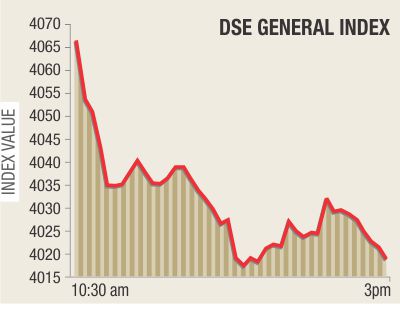 Stocks opened the week with downward pressure yet again, thanks to investors' selling spree in anticipation of a bear run.
DGEN, key market tracking index of Dhaka Stock Exchange (DSE), finished the day at 4,018.06 points, after dropping 48.18 points or 1.18 percent.
Trading at the premier bourse started an hour late at 11:30 am due to technical fault.
“This problem will not re-occur again as we have already rectified it once and for all,” a DSE official said.
The bourse observed active sell pressure from the very beginning and to end the day in the red.
“The bourse got another blow by way of a countrywide eight-hour long road blockade. Most of the securities from every sector suffered from price corrections amid increased political violence during recent periods,” said IDLC Investments in its daily market commentary.
IPOs attracted investors' interests the most. For instance, Envoy Textile which debuted today obtained a 23.47 percent turnover, added the merchant bank.
“Market traded with bearish momentum all through the trading session. Although the current economic scenario is sluggish, forthcoming financing prospects and improving economic indicators suggest long-term prosperity” said LankaBangla Securities in its market commentary.
The stockbroker added: “Investors are discounting the fact that the financing prospects of Padma Bridge have become bleak again due to the World Bank and the government failing to reach an agreement.”
Turnover, however, remained almost flat compared to the previous session at Tk 213 crore, with 5.18 crore shares and mutual fund units changing hands on the premier bourse.
Losers beat gainers by a huge margin of 214 to 37, with 13 securities remaining unchanged on the DSE floor.
All the major sectors posted losses on the day: non-bank financial institutions dropped 1.89 percent, followed by power 1.65, banks 1.56 percent, telecommunications 0.72 percent and pharmaceuticals 0.46 percent.
Envoy Textile was the most traded stock of the day, thanks to its transaction of 80.21 lakh shares worth Tk 50.16 crore.
The company also was the biggest gainer of the day, posting a 106 percent gain.
The Jamuna Oil Company was the worst loser of the day, plunging by 27.64 percent.
News: The Daily Star/Bangladesh/10th-Dec-12
Stocks return to the red again
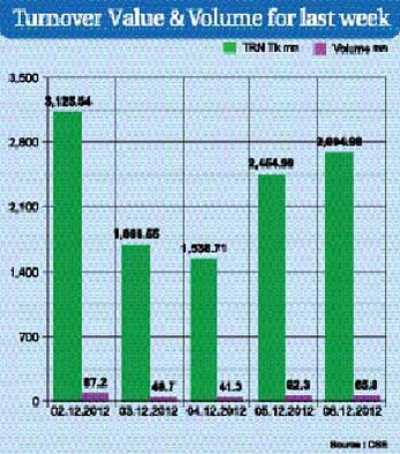 Stocks returned to the red again after meagre improvement in the previous week as ongoing downtrend and subsequent fear of unknown bottom is still puzzling the investors to come out of the 'wait-and-see policy'.
The market witnessed five trading sessions as usual. Among those, four sessions lost 150.72 points while one session gained 6.39 points.
Week-on-week, the prime index of the Dhaka Stock Exchange, DGEN, plunged 144.33 points or 3.43 per cent to close at 4,066.25.
The all share price index DSI went down by 120.09 points or 3.37 per cent to end at 3,440.01. The blue-chip index DSE-20 also lost 96.47 points or 2.82 per cent to close at 3,319.69.
The Chittagong Stock Exchange also declined with the CSE Selective Category Index falling by 265.48 points or 3.24 per cent to close at 7,901.52.
"Addition of a new listing barely helped the market to recover. There was only one positive session during the entire week. Average volume and turnover continued to decline amid poor participation of investors," commented LankaBangla Securities in its weekly market analysis.
"During the week, World Bank's visit regarding Padma Bridge financing issue failed to create positive sentiment, while in earlier months, the investors overreacted to the issue as the bourse was responding quicker to come out of the illusion of knowledge and resulting impulse trading, especially in the current downtrend," the IDLC Investments said in its weekly market analysis.
In the midway of the week, 'hartal day' made the market slow as hartal sentiment influenced the market pulse. As a result, the investors were not keen to participate and turnover hit the five months' low, the IDLC analysis said.
The investors adopted a 'wait-and-see policy' amid increase of political violence. However, Generation Next Fashions created buzz which gained by 335 per cent and occupied 15.52 per cent of total trade on debut trading session, it added.
Week closed over falling sentiment. News of gloomy outlook over much wanted Padma Bridge financing by World Bank scared the market. However, it had not affected the market like before. Fear of unknown bottom of ongoing downtrend is still puzzling investors to come out of the 'wait-and-see policy', it added.
News: The Daily Financial Express/Bangladesh/8th-Dec-12
Addressing the problems of the SCBs
Fahmida Khatun concluding her three-part write-up on the 'State of governance in the banking sector: Dealing with the recent shocks
The recent financial scam is an eye-opening incidence for all associated with the banking sector as well as the policymakers exposing the inherent weaknesses of the banking sector of the country. In view of the recent irregularities, appropriate measures ought to be undertaken in the short to the medium term towards improved performance of the sector. This should range from proper investigation and punishment of involved persons to improvement of the monitoring and governance of the SCBs.
Specific recommendations are the followings:
Absence of risk management policy: The absence of a comprehensive risk management policy in many banks makes it difficult to handle fraud and other extra-ordinary cases. The Bangladesh Bank (BB) has identified six core risks and asked banks to formulate and implement appropriate guidelines on those. These core risks include the following: (i) Credit Risk Management; (ii) Foreign Exchange Risk Management; (iii) Asset-Liability Risk Management; (iv) Internal Control and Compliance Risk Management; (v) Money Laundering Prevention Risk Management; and (vi) Guidelines on Information and Communication Technology.
Such guidelines, however, are hardly followed by most of the banks, specially the SCBs. The manual for loans and advances containing policies, procedures, processing and reporting of transactions, review of security and collateral and responsibilities at different levels is not followed by many banks due to which it becomes difficult for them to handle and manage clients with various levels of exposures.
Lack of internal control: The Internal Control department which ought to be the most critically important department of any bank is weak in the state-owned commercial banks (SCBs). This is mainly due to incentive failure which prevents hiring of qualified persons for this department. As the nature of the job involves patient scrutiny of compliance, people are reluctant to work here, and those who do, are often in a way dumped in this department. Absence
Lakes of information technology (IT) makes their work even more boring. Bangladesh Bank guidelines on internal control require that if there is any incidence of a loss equivalent to Tk. 10 million (1.0 crore) the Board of Directors of Banks should be informed immediately. Besides, any major irregularities, fraud and embezzlement have to be presented through a report during the monthly assessment of banks. In the case of Hall Mark scam, it seems that the bank management was hiding the illegal activities in the said branch for a prolonged period.
Political baggage of the Board of Directors: The tradition and practice of appointing Directors of the Board of the SCBs based on the political loyalty and affiliation have to be changed. The members of the Board of the SCBs should be independent, qualified, efficient and socially acceptable persons with unquestionable integrity. Bangladesh Bank Guidelines 2010 for the Directors of banks spelt out the 'Fit and Proper Test Criteria' for the nomination of Directors along with their responsibilities and power. These criteria are yet to be implemented fully.
Due to political baggage, the Directors of SCBs cannot perform their duties independently and remain morally obliged to listen to political instructions of the government. This results in weak corporate governance. As the Broad members are also the members of various committees of a bank constituted to closely guide various operations of the bank, the independence of the audit committee, the most important board committee which has to ensure compliance of business strategy and policy of the Board, cannot be maintained as well. Given the emerging challenges and dynamism of modern banking business, it is thus important that Directors of the Board have the pertinent knowledge and skill of running bank with efficiency and sincerity.
The accountability of the Directors should also be determined clearly. In case of the Hall Mark scam, it has been reported that the Board was not informed of the unscrupulous inland bill trading. However, the fact that the responsible branch was not audited and the accused branch manager was not transferred even after completion of his three years tenure are some of the issues which the Board cannot shrug off its oversight responsibility.
Inappropriate appointment of CEOs and senior officials: The scam has also exposed total failure of the Chief Executive Officer (CEO) and responsible senior managers of the bank in discharging their duties. In the SCBs, the pre-occupation of most CEOs is to keep the Board in good humour and sing the songs the way the Board likes to hear so that their position is well secured under any circumstances. It is difficult to find any instance where the CEO has been asked to leave the job because of bad performance. One may argue that in a setting where the Board is constituted of political candidates, the CEO is handicapped in taking any decision guided purely by banking ethics, norms and perceived risks. This, however, is not a saleable point.
Good business plan, effective people management programme, regulatory compliance practice, effort towards clients' satisfaction and high work ethics of any CEO of a bank are bound to be endorsed by a Board, no matter how political it may be. The performance of CEOs should be evaluated from time to time by the Board based on Key Performance Indicators (KPI). The Board can only guide and support the CEO to achieve the targets that are of benefit to the bank.
In appointing GMs, suggestions have been made to have a common and single selection and promotion committee under the BB and the Ministry of Finance for selecting GMs or promoting DGMs to GMs and for posting them in different banks following their selection. GMs should also be transferred from one SCB to another in order to not only help transfer of good practices, but also to reduce the possibility of fraudulent and unethical practices.
Shortcomings of human resource policy: Human resource (HR) development has been a neglected issue in the SCBs. As mentioned earlier, the World Bank supported reform of 2007 recommended a number of measures for the improvement of skills and performance of the officials in the SCBs. However, the HR department of the SCBs remains weak and powerless to take decisions on recruitment and promotion, partly due to lack of capacity and partly due to external influence.
In the modern day business, banks have to provide value added products and services to customers in addition to traditional banking functions. However, the SCBs suffer from lack of skilled and qualified human resources for undertaking such operations. The HR policy of banks should not only arrange for appropriate training, but should also include the reward and punishment practices of the bank.
Inertia for automation and management information system: An issue related to the HR development is the automation and management information system (MIS) in banks. It is apprehended by experts with fair amount of certainty that there may be many more Hall Mark cases that wait to be uncovered in other banks. Unless these are dug out through transparent and automated banking practices with the help of IT, the mess may be piled up and reach an unmanageable stage. Even after several reform initiatives, the inertia of the SCBs in adopting IT-based banking services and the MIS is not only disappointing but also quite surprising. Due to lack of MIS, the Hall Mark case was not detected in time even though clearing was going against SBL continuously for many months due to loan increase in a branch of the bank.
There have been comprehensive programmes for the last several years to establish automated clearing house and credit information bureau (CIB), computerisation of the head offices and branches of all banks, electronic banking services, online corporate banking service, electronic fund transfer, automated teller machine (ATM) and internet banking. While all the foreign banks (FCBs) and most private commercial banks (PCBs) have implemented these automated and electronic banking services, the SCBs are way behind in meeting these requirements. This is not only affecting their efficiency and profitability, but also giving rise to opportunities for committing scams such as the Hall Mark.
The archaic manual system of transaction records has indeed facilitated the Hall Mark forgery. It is mentionable here that as part of the reform programme, the World Bank had supported a consultant in the rank of the General Manager (GM) for IT in the SCBs for two years with a higher compensation package. GMs for IT were supposed to work on procuring computers, developing and buying software, and training officials of the SCBs. These initiatives are yet to see any meaningful result as the automation process is almost non-existent in the SCBs.
Dualism in the regulatory mechanism and regulator's oversight: It is no secret that there exists a strained relationship between the BB and the Ministry of Finance (MoF) over the supervisory and regulatory role on the SCBs. Though the BB can exercise its full authority in supervising the private commercial banks (PCBs) and foreign banks (FCBs), the MoF oversees the SCBs to some extent. The MoF appoints the Directors of the Board, CEOs, DMDs and GMs of the SCBs. However, due to less articulated mandate, the BB faces problems in implementing recommendations of audits and ensuring overall governance of the SCBs.
Full autonomy of the central bank has been suggested by many concerned stakeholders including the donors. The International Monetary Fund (IMF) has asked for amendment of the Banking Company Act (BCA) giving full legal supervisory and regulatory authority of the BB over all commercial banks by September 2012 as a pre-condition for contracting a loan to Bangladesh for USD 987.06 million under the Extended Credit Facility (ECF) in April 2012. There has also been suggestion by many to dismantle the Banking and Financial Institutions Division at the MoF in order to keep the SCBs away from political influence. While this is necessary for smooth functioning of the banking sector the supervisory and monitoring role of the BB needs to be significantly strengthened as well.
Though the MoF is in the driving seat to monitor and control the SCBs, the BB has to perform audit and inspection in all commercial banks including the SCBs. As in the other previous financial chaos in the country such as the capital market debacle, the BB played a reactive role long after the irregularities have actually been in place. Firm supervision and effective monitoring could have controlled the damage suffered by the Sonali Bank Limited (SBL). The fact that clearing of SBL was going against the bank, the amount of loan was increasing, and finally the bank became a borrower from a lender in the inter-bank market, indicates the weak off-site supervision mechanism of the BB.
Need for a commission for the financial sector: Though the country's banking sector has achieved considerable success due to the reforms in the 1990s and 2000s, it still needs to be prepared well for the next generation global regulatory framework and to meet emerging clients' needs. In the coming days the banking industry will have to achieve the ability to absorb shocks arising from financial and economic stress, improve risk management and governance, and strengthen banks' transparency and disclosures through complying with Basel III requirements which is scheduled to be introduced from 2013 until 2018.
In view of the recent shocks in the banking sector and emerging challenges, a Commission for the financial sector should be formed which will scrutinise the overall performance of the sector, assess the need of customers and the economy, identify the current problems and emerging challenges, and suggest concrete recommendations for prudential banking to be implemented in the short to medium terms.
Considering the emerging need and in order to build up more transparent and responsible banking sector, the Commission can also include non-bank financial institutions such as insurance companies and capital market under its jurisdiction as they are interconnected. The broad terms of reference (ToR) of the Commission will be to critically assess the problems and weaknesses of the banking industry in order to find whether there is any disconnect between demand of the growing economy and the realities of a backdated financial system that is failing to meet the emerging need. On the basis of a comprehensive scrutiny, the Commission will prepare guidelines and make recommendations as regards automation, risk management, internal control, the role of various players in banks and other financial institutions.
Concluding remarks: The Hall Mark incidence is not only a case of financial loss, but also a deep dent on the confidence and trust of the customers of the bank. It is also not about the loss of good will of the particular bank only, but of the total banking industry. Such an erosion of reputation of banks could have multiple chain effect including reduction of deposit in the concerned bank and fall of share prices of the whole banking sector. This can also constrain the role of the banking sector in catalysing the growth of the economy. Without radical changes in the banking practices of the country such expectations may remain largely unfulfilled. During the run-up to attaining the ambition of being a middle-income country there is a need to significantly strengthen the banking industry if goals are to be realised.
From the 1990s onwards, the Bangladesh economy has evolved, and the banking sector has evolved as well. With the speed-up of economic growth through higher investment the demand on the banking sector will still be higher. This reiterates the need for improved efficiency of the sector in terms of resource allocation for the productive sectors and management. As the global regulatory environment is becoming tighter, global economic environment is facing more volatility and resources are getting more scarce, banks in Bangladesh will have to find innovative ways to conduct their business. There will be demand for higher capital and more skilled human resources for smooth functioning of banks and for ensuring compliance in the coming days.
Therefore, the banking sector in Bangladesh has to focus on using both its financial as well as human resources in a far more innovative and efficient way to cater to the demands of the future.
The writer is an Economist and the Head of Research at the Centre for Policy Dialogue (CPD). This write-up in three parts is a shorter version of the paper presented at a dialogue organized by CPD on November 05, 2012. fahmida@cpd.org.bd
News: The Daily Financial Express/Bangladesh/10-Nov-12